
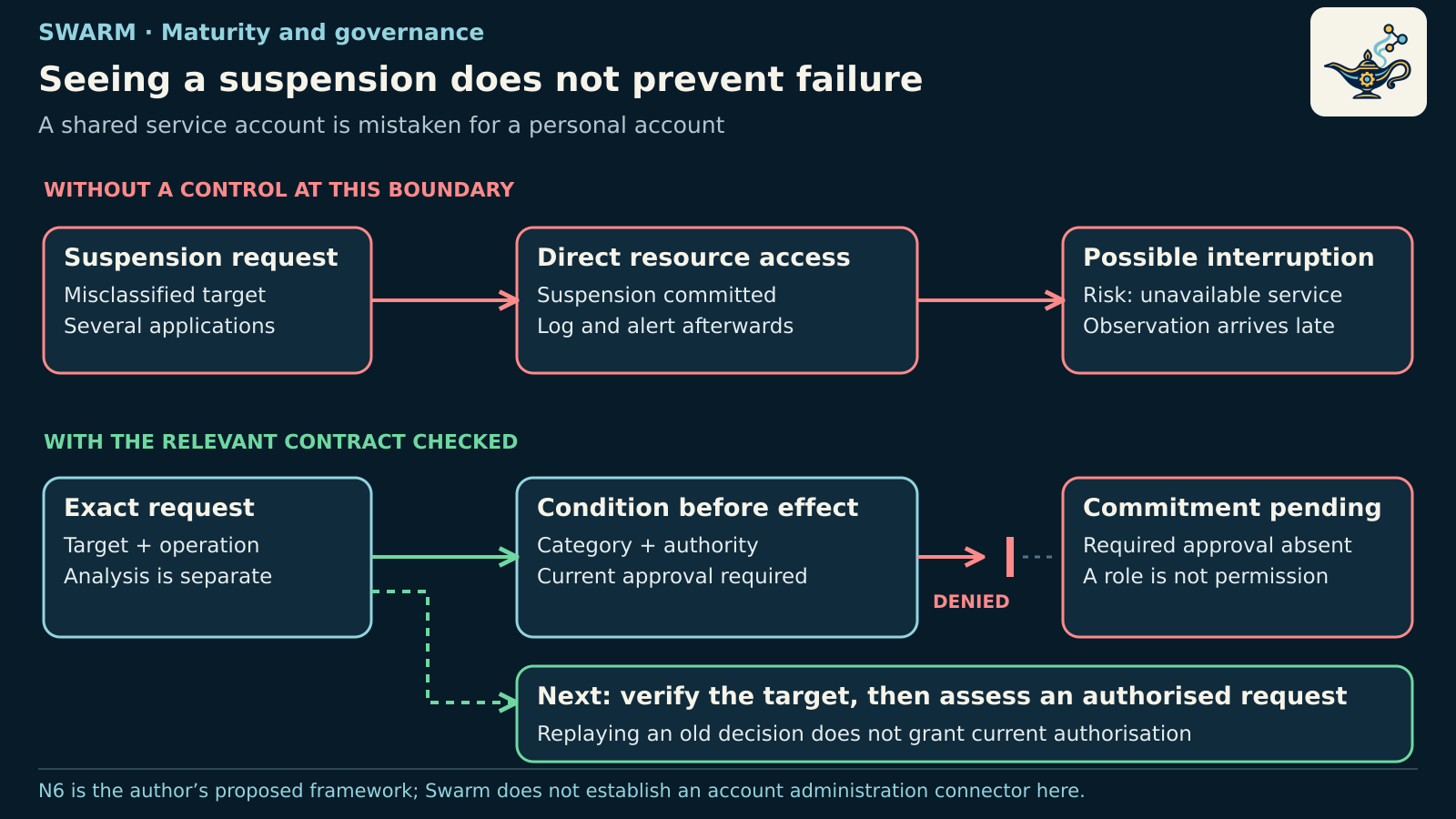
A dashboard can display a dangerous action without being able to stop it. This distinction matters when an AI agent has permissions over systems used by several teams. Knowing what happened and controlling what may be committed are different properties.
In my framework for discussing agentic maturity, I call the effort to connect orchestration with explicit, verifiable execution conditions “level 6”. This numbering belongs to my proposal. It is neither a recognised standard nor a qualification achieved by Swarm. The useful criterion is observable: can an action reach the resource without satisfying its required conditions?
One account, several affected applications
Consider an operations agent investigating a suspicious account. Its name resembles a personal account, but it is a service account shared by several applications. The agent proposes suspension. If it can directly administer accounts, a classification error could interrupt those applications.
A log can later explain who requested suspension. An alert can accelerate response. Neither guarantees prevention of the interruption. To prevent the effect in this scenario, a condition must be enforced before the resource changes: suspending this category requires explicit approval for the exact target.
Observation informs action; a mandatory condition constrains an effect only when enforcement precedes that effect.
Refusal need not stop investigation. Authorised analysis can continue, dependencies can be checked and a corrected request assessed. Separating analysis from commitment prevents supposed urgency from implicitly expanding a mandate.
Deterministic does not mean infallible
Another model can flag anomalies or enrich analysis. Its recommendation alone does not establish a mandatory condition. Deterministic rules check explicit inputs and produce a defined decision for a given state and policy.
Every material input must be retained: identity, delegation, resource, operation, parameters, observed state, policy version and temporal conditions. Replaying a historical dossier supports examination of its decision. It does not authorise the operation today: the mandate may be revoked and account state may have changed.
A rule can also be wrong or rely on stale inventory. Reproducible enforcement does not correct that limitation. Determinism supports examination of a decision; it does not make every input true.
Connect decisions to enforcement
Producing rules and applying them to resources are different responsibilities. An architecture may separate management, distribution and consumption, but signing a policy package proves neither freshness nor receipt of the latest revocation.
If policy distribution becomes unavailable, behaviour must be defined for the action, validity conditions and accepted risk. A cached policy cannot be assumed valid indefinitely. A sensitive commitment whose conditions cannot be established may need to remain pending. That choice has an availability cost.
The access path is equally important. A control that the agent can avoid by choosing another tool cannot impose its decision on that path. Actual access must be assessed, including child processes and service identities.
A verifiable reference, within its scope
For this account, an identity directory may help establish category and dependencies. Its origin, currency and susceptibility to alteration still require examination. A digest binds bytes; it does not prove a classification correct.
Comparing an extracted value with a reliable reference can detect a defined discrepancy without establishing complete business suitability. Compilation and tests are partial controls, not universal correctness oracles. Explanations require comparison with observable facts and the operation’s conditions.
Implications for Swarm
Swarm contains a transition engine, evidence checks and a Trust pilot with simulated effects. Successful controls remain distinct from human approval when required. These mechanisms support examination of the relationship between a request, its conditions and a decision.
They establish neither an account administration connector, effective suspension of an identity nor global operating system or network confinement. Identity and memory contracts remain partial, and overall qualification is open. No decision latency, immutable log or general regulatory compliance follows from this architecture.
Relevant evaluation would examine a misclassified target, stale approval, unavailable control and an alternative access path. It would observe the effect prevented or committed and the conditions for recovery. The maturity sought is established by contracts and evidence rather than the number on a diagram. The Swarm repository exposes its current state.